Description
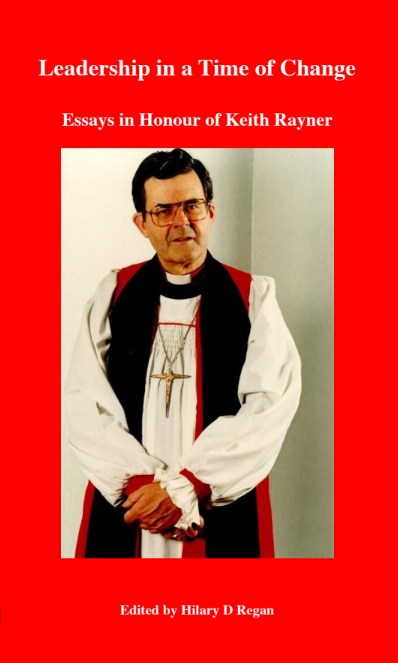
This book is a collection of essays in celebration of the life and ministry of Bishop Keith Rayner (1929–2025). The title Leadership in a Time of Change sums up a widely held view of Bishop Keith’s leadership in three Dioceses of the Anglican Church of Australia, especially as Archbishop of Adelaide (1975–1990) and Melbourne (1990–1999), and as Primate from 1989 to 1999.
Bishop Keith’s many contributions to the national Anglican Church included his support for Indigenous reconciliation, the poor and marginalised, and his role in progressing women’s ordination. On an international level, his contributions to the Lambeth Conferences in 1988 and 1998 were especially significant, as was his long presidency of the Christian Conference of Asia. Keith Rayner was a great man, an intellectual giant, a man of profound faith, and a sympathetic and self-effacing bishop and leader. As Hamlet said of his father, ‘He was a man, take him for all in all, I shall not look upon his like again’. If the recollections in this book can capture a little of the story of a deeply committed Christian priest and bishop who in his long life helped to shape national and international attitudes within Church and society it will have played its part.
From the Foreword by The Rev’d David Richardson AO OBE
About the editor
Hilary D Regan has been the Publisher of ATF Press Publishing Group for over 30 years and is editor of various of the ATF Press journals. He has a background in Systematic Theology.
David Hilliard
Address at the launch of Hilary D. Regan (ed.), Leadership in a Time of Change:
Essays in Honour of Keith Rayner
St Peter’s Cathedral, Adelaide, 28 January 2026
The Anglican Church of Australia has had many influential leaders. However, because the church is geographically dispersed and theologically diverse their influence has usually been confined to particular states or to those of their own theological outlook and they have not been national figures. Keith Rayner was one of the few primates who was a national figure and who was respected across the whole Australian church, despite difficulties with the militant wing of the diocese of Sydney. He steered the diocese of Adelaide, and during the 1990s, the national church, through the divisive debate over the ordination of women. He sought to maintain the unity of the Australian church and he succeeded but not entirely. During the last twenty years the Australian church has divided over other issues, the common ground has diminished, and there are few leaders of Keith Rayner’s stature.
While thinking about this event I tried to recall my interactions with Keith Rayner during his years in Adelaide. In the early 1970s I was not closely connected with the church. I was away from Adelaide when he was elected and when he was enthroned in May 1975. But I did pick up the gossip that many of the younger clergy were looking for a change of direction in the diocese, a leader who was less suspicious of contemporary movements in the church, and their hope that the young bishop of Wangaratta would provide some much-needed fresh air. During his first years in Adelaide the new archbishop was something of celebrity. When he made his first pastoral visit to a parish he invariably drew a large congregation, with many people coming from elsewhere, eager to see and hear him. His sermons on these occasions – typically vigorous in delivery and with solid content – did not disappoint them.
In 1978 I appointed by the diocesan council to the council of St Barnabas’ College to replace the professor of Physics at Flinders University who had served several terms. On 9 August, my diary records, I attended my first council meeting and met the archbishop who chaired it. He entered the room on the dot, as the clock struck eight. It was an old-fashioned committee. I recall a meeting on a very hot December evening when I was the only person in an open-necked shirt, and members were invited by the acting chair to remove their jackets if they so wished. It was a significant period in the history of St Barnabas’ College. With the archbishop’s active encouragement, theological education became an ecumenical activity. In 1979 the college became a founding member of the Adelaide College of Divinity, initially comprising all the theological colleges in Adelaide, which taught for degrees in theology awarded by Flinders University. The college built its first accommodation for married students. There was a fierce controversy over the archbishop’s appointment of John Gaden to succeed Edmund Randall who been warden of the college since its reopening in 1965. I was a member of the sub-committee that decided to appoint John Gaden and at a tense meeting of the college council in September 1985 it fell to me to move the endorsement of his appointment.
In 1978 the archbishop invited me to be on the selection panel for ordination candidates, meeting over a weekend at the Retreat House at Belair. This was the first of these annual selection conferences; my job was to assess the candidate’s intellectual ability. It was a sign of the vigour of the diocese at that time that there were some fifteen (mostly young) men at the conference of whom we selected about half. It was the same the following year.
The first half of Archbishop Rayner’s episcopate in Adelaide was one of much needed reform, new initiatives and optimism. Then in the early 1980s the atmosphere of the diocese changed. The debate began over the ordination of women and the clergy split into factions. A large group of Anglo-Catholics, led by Father John Fleming, created a powerful network to oppose it. They saw the archbishop’s support as a betrayal of the Catholic tradition in the Anglican Church. The archbishop felt the pain of their suspicion and regretted the politicisation of the clergy. The worst year was 1987: ‘probably the most troubled in my eighteen years as a bishop’, he told the diocesan synod that year. Then the clouds lifted and his final years in Adelaide were happier. Many of the Adelaide clergy who initially resisted the ordination of women later changed their minds and now accept the ministry of women though a few remain resentful.
Two events in Keith Rayner’s later life reveal something very attractive about him. In Melbourne on Australia Day 1995, at the suggestion of a Roman Catholic friend, I attended a Mass in St Patrick’s Cathedral, to celebrate the beatification a few days earlier of Mary MacKillop, co-founder of the Sisters of St Joseph (the step towards her canonisation in 2010).
The cathedral was packed with several thousand people so much of the congregation had to stand. I was in a corner of a transept, then realised that standing next to me was Archbishop Rayner, not in his official capacity as Anglican primate but as an individual Christian honouring a great Christian from another tradition within the universal church. The second occasion was in December 2013 when I attended a special service in St Peter’s Cathedral in Adelaide, organised by the South African-born dean – a memorial service of thanksgiving for the life of Nelson Mandela. And once again a figure dropped into a vacant seat next to me and it was Bishop Keith. Again, not in any official capacity but as an ordinary South Australian with an interest in South Africa wanting to honour a great man.
In his retirement, and after the death of Audrey in 2011, I occasionally visited Bishop Keith at his home in St Georges for a chat. On one occasion Janet Scarfe and I took him out for a coffee at Burnside Village. Sometimes we exchanged books. He kept up serious reading and of course liked to know what was going on in the church, though he rarely commented on people or events. One by one his closest friends among the bishops died. On one of my last visits he remarked rather sadly that for the first time he no longer knew any of the current bishops in the Australian church. They had started emerging as church leaders after his retirement as primate over twenty years earlier.
I would like to think that it was Keith Rayner’s training as an historian that was a major source of his great strength as a church leader. He had span. He could see ideas and movements in their historical context. He knew that many received church teachings and practices were historically conditioned. They had changed or modified over time as society changed and with new insights from science and biblical scholarship. His own theological outlook quietly shifted over time, away from the strict Anglo-Catholicism of his early years. His sympathies had widened. Therefore, he was instinctively distrustful of absolutist positions that claimed to be totally correct because always he saw the counter-arguments. Sometimes people sniffed at his ‘On the one hand and on the other’ approach but he was never wishy-washy or bland. There is much to be said for his approach which embraced complexities and contradictions. He recognised that every Christian tradition had distinctive insights and treasures but they also had weaknesses and lop-sided emphases. He valued Anglicanism with its all its messiness but did not regard it as a divinely inspired creation. He related easily to the leaders of other Christian denominations, without any Anglican assumption of superiority, and was much admired by them.
Keith Rayner was a towering figure in the Anglican Church of Australia during the latter decades of the twentieth century. I am delighted that it has been possible to compile this book of essays to commemorate his influential ministry, and I congratulate Hilary Regan who has brought the project to completion.
-
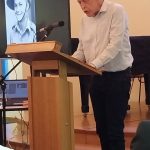
- David Hilliard
-
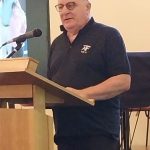
- Hilary Regan
-
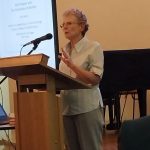
- Janet Scarfe
Janet Scarfe
Leadership in a Time of Change: Essays in Honour of Keith Rayner
Launch, 28 January 2026,
St Peter’s Cathedral
Thank you Hilary and Bishop Keith’s family, Philippa, Jill and Chris, for the opportunity to speak about Bishop Keith and the women’s ordination controversy in the 1980s and 1990s.
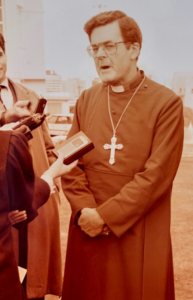
Archbishop Keith Rayner speaking to media
about women’s ordination to the priesthood,
General Synod, Sydney, July 1992
(Anglican Archives, Diocese of Adelaide)
Dr Muriel Porter has contributed the relevant chapter in the book being launched tonight. Muriel cannot be present so I am honoured to say a few words.
Muriel and I were friends but experienced the issue from different vantage points. Muriel has been a leading lay woman in Melbourne and the national church, and recognised for this with the Medal of the Order of Australia. She was deeply involved in the campaign for women’s ordination, most notably through the church’s decision-making processes including General Synod. She fought hard for women in the episcopate which came to fruition in 2008. Her essay reflects her abiding respect for those processes, a respect she shared with Bishop Keith.
My involvement was through the Movement for the Ordination of Women, the activist group which lobbied from the edge of the church structures. I followed the visionary Dr Patricia Brennan as national president in 1989 so was in that role during the worst moments of the fight. Part of my role was ensuring the controversy was kept in the public eye, which was not hard! I sent accurate information to the media and to the church authorities, particularly about the growing number of women deacons around the country and their extensive ministries. In fact at the beginning of that crucial year 1992 there were 172, plus three women ordained priest in dioceses overseas whose orders were not recognised. (One was Caroline Pearce from here in Adelaide.) MOW was visible and loud. We dismissed pious platitudes about women’s ministry and the minor concessions that many bishops offered. Some pro-ordination supporters – including some of the women seeking ordination and perhaps Bishop Keith – worried that we damaged the cause. I truly doubt we did any damage at all.
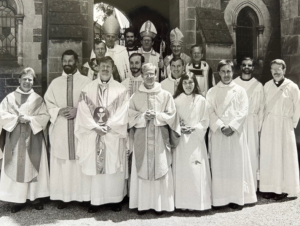
First ordination of a woman in the Diocese of Adelaide
the Reverend Joan Claring-Bould, ordained deacon, 5 December 1987
(Anglican Archives, Diocese of Adelaide)
In her enlightening chapter, Muriel refers to Bishop Keith’s approach to and support for women’s ordination as ‘cerebral’, essentially theological. That was true for part of his episcopate but it changed, I believe, softening into something deeper after his translation to Melbourne as archbishop in 1990.
When Bishop Keith arrived in Melbourne, the diocese was still grieving the untimely death of Archbishop Penman. David Penman had championed women’s ordination with theological conviction and practical action. The Evangelical-Catholic divide there was less pronounced than in other dioceses: in fact liberal Catholics and liberal Evangelicals found common cause in the crusade for women’s ordination. Evangelically aligned Ridley Theological College supported a good number of women seeking ordination. Women had been recognised as Anglican chaplains in big Melbourne hospitals for years, without any requirement for ordination. Several woman deacons were in charge of good-sized parishes. (From a personal point of view as I lived there then, the Anglican Church in Melbourne was exciting, invigorating and even life changing.)
As Archbishop of Adelaide, Bishop Keith ordained less than a handful of women as deacons. In Melbourne he inherited a significant number and added more himself till there were around 50 women deacons in that diocese alone. Most believed they were called to the priesthood. Many had years of professional ministry behind them as deaconesses, pastoral workers, hospital chaplains and missionaries. Some had ministered as clergy wives. Elizabeth Alfred had been a deaconess since 1944. Elizabeth Smith was a liturgist whose subtly inclusive language hymns were already sung at ordinations and in parishes around the diocese. (Some are in Together in Song; some of you will have sung them). Two of the first deacons, Barbara Darling and Kate Urwin, later became bishops.
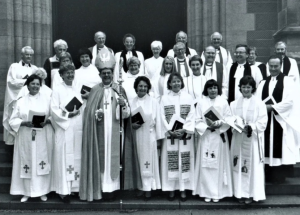
First ordination of women to the priesthood, Diocese of Melbourne
13 December 1992
Later bishops: Barbara Darling (far left); Kate Urwin (far right)
General Synod finally passed the canon for women’s ordination in November 1992, and Melbourne synod adopted it quickly. That December Archbishop Keith ordained 33 women deacons as priests in three separate services in St Paul’s Cathedral. By Christmas there were 92 women priests around the country. He had ordained nearly a third of them.
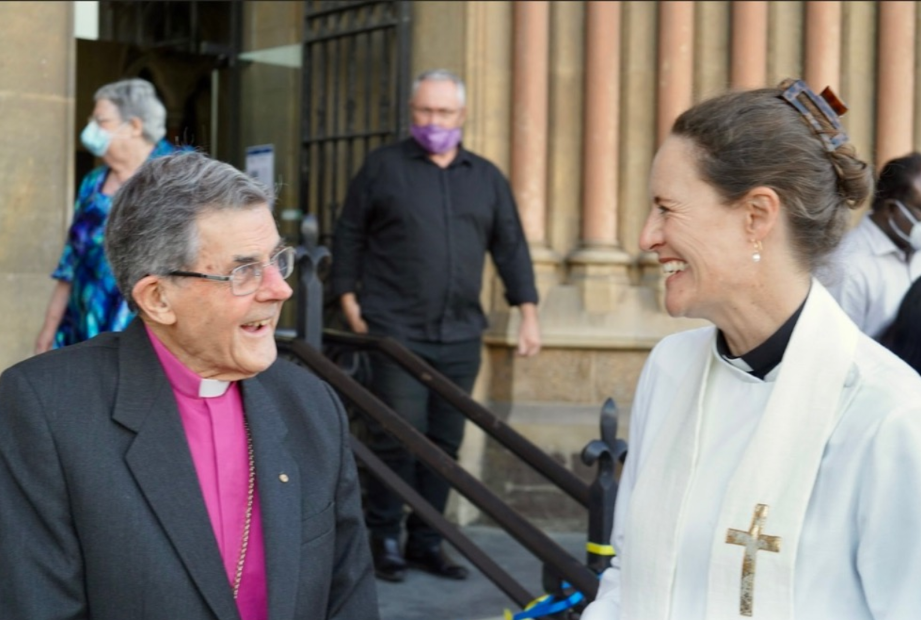
Bishop Keith Rayner and the Reverend Sarah Wiles (Diocese of Willochra), March
2022
I’m skipping 30 years to 2022, to the 30 th anniversary of the first ordinations of women to the priesthood. Thanksgiving services took place in dioceses around the country. Two were held here at St Peter’s Cathedral. The first one in March coincided with the national
conference of bishops, at which 6 of the 7 women bishops were present. Bishop Keith sat in the congregation but this wonderful photo of him afterwards with the Reverend Sarah Wiles from Willochra is worth a thousand words.
Later that year on 4 December, a second celebratory service was held. It was the Sunday nearest the date when women were first ordained priest in Australia after the passing of the General Synod canon, here in Adelaide. (Archbishop Carnley of Perth had already ordained
ten women the previous March on the basis of that diocese’s own legislation.) It was also the 35 th anniversary for the first woman deacon in this diocese, Joan Claring-Bould. Aged 93
Bishop Keith stood at the lectern and reflected that 30 years on was an appropriate time to ‘recognise the blessings the church has received’ from the ordination of women. He then spoke candidly about the struggle, and the effect it had on his sense of episcopal leadership. The issue he said gave him some of the ‘most anxious and demanding of his years’ in the episcopate. He spoke of the ‘masculinity that has dominated the church’s governance and ministry’, and acknowledged ‘the pain and suffering that was the lot of many of the pioneers’. (You can see his talk on the Cathedral’s youtube channel, ‘Choral Evensong 4 Dec 2022’).
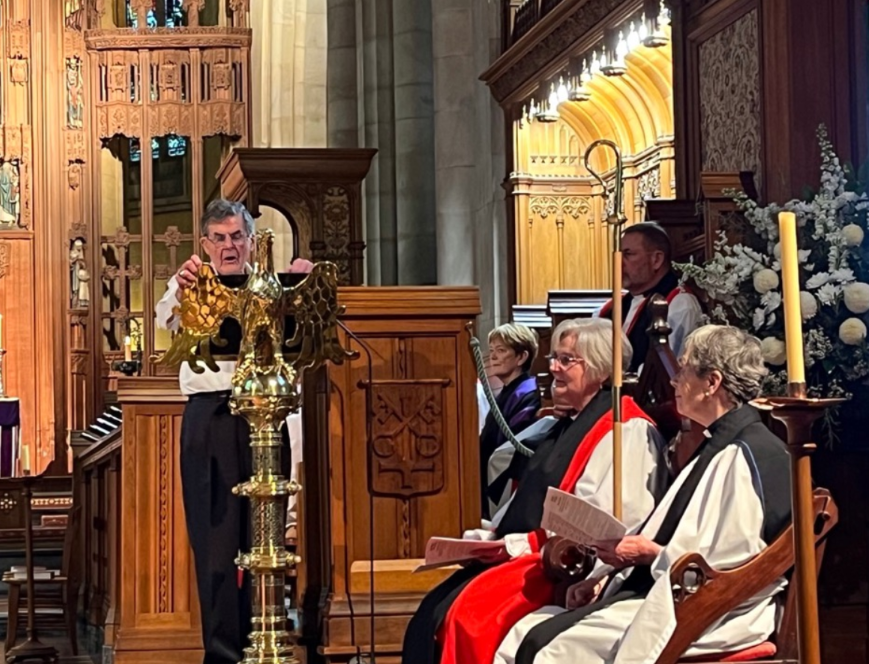
Bishop Keith Rayner speaking at the 30th anniversary service
St Peter’s Cathedral, Adelaide
4 December 2022
Back: Bishop Chris McLeod
L-R: Lavinia Gent, Bishop Denise Ferguson, Reverend Susan Straub
A similar service was held in St Paul’s Cathedral Melbourne a fortnight later. Bishop Keith sent a letter which was read to the congregation. In it he said that the ordination of women had ‘led to a gentler, more inclusive church, better attuned to the needs of the age.’ His words were heart-warming but the effect could not compare with the sight and sound of him speaking from his heart that earlier occasion in St Peter’s Cathedral.
Bishop Keith had long voted for and expressed support for women’s ordination, but he worried deeply about the consequences for church order. He came to the realisation that the integrity of church order was deeply flawed if it led to the denial that God called women as well as men to be deacons, priests and bishops. His time in Melbourne was a decisive part of that change of heart and understanding.
Bishop Keith retired before women could be bishops in the Anglican Church in Australia. He did not experience women as episcopal colleagues or equals as archbishops. He would have treated them with unfailing courtesy; that goes without saying. I am certain he would have done much more than that. After a nervous moment perhaps, he would have genuinely welcomed the insights, perspectives and wisdom they brought to the House of Bishops. We will never know; the church processes were too slow and he was born a bit too soon.
Janet Scarfe
28 January 2026