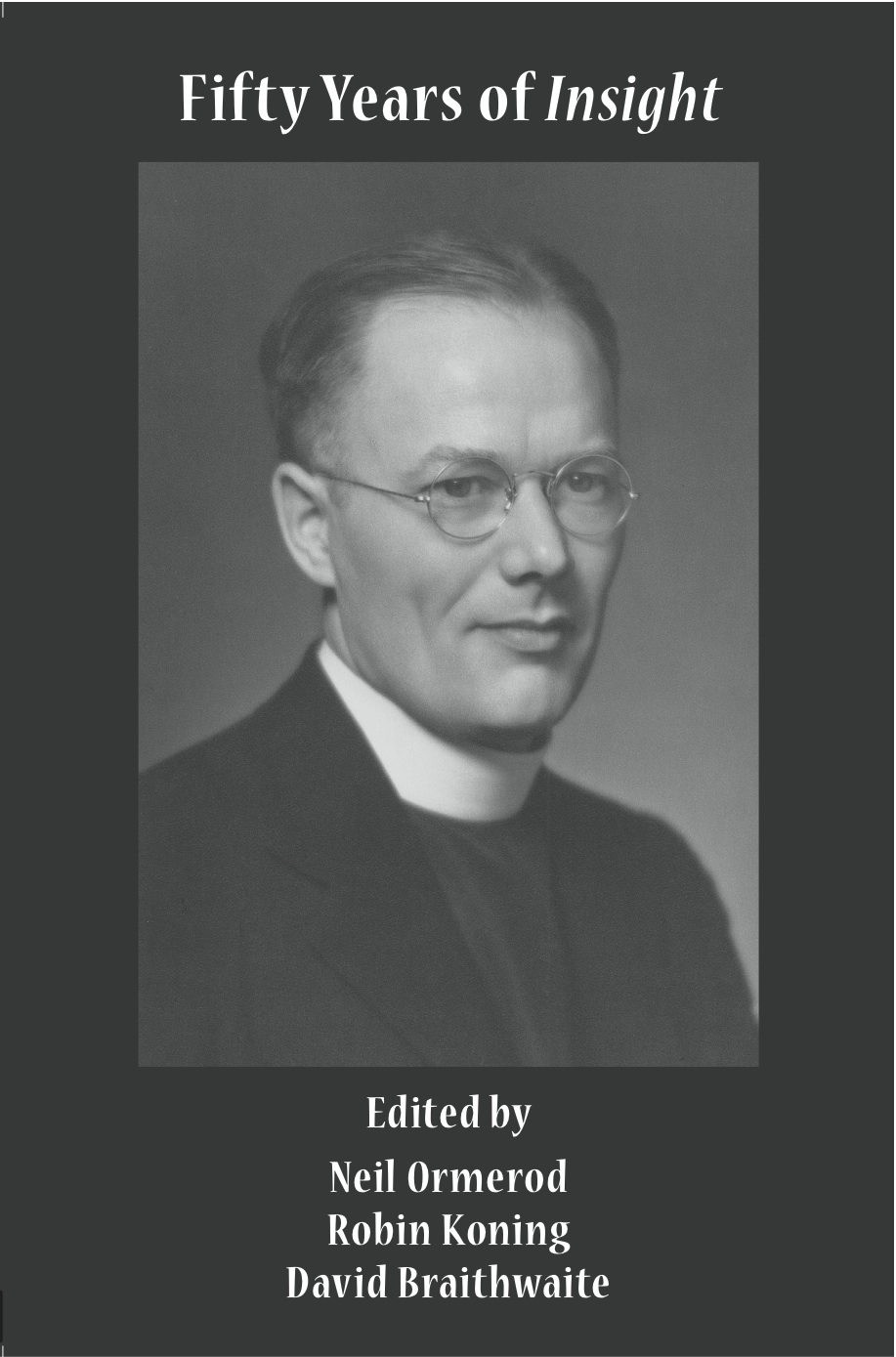
Description
Bernard Lonergan is one of the greatest Catholic intellectuals of the twentieth century. His writings cover an enormous range of topics including philosophy, theology, science, history, art, education and economics. His collected works, currently being published by University of Toronto Press, will number over twenty volumes. However, for most people he is best known for two works, Insight: A Study of Human Understanding and Method in Theology. If these were the only two works he ever wrote, his reputation would be undiminished, marking him as a unique mind capable of the most profound philosophical and theological analyses. Perhaps because of the profundity of his writings he nonetheless remains an intellectual terra incognita for many people. He has a well deserved reputation for being difficult to read, particularly if one’s starting point is Insight. It is not that his writings are particularly dense or obscure, but his appeal to mathematical and scientific examples can leave an unprepared mind floundering. His writing assumes a reader who is at the ‘level of the times’, abreast of the scientific and cultural achievements of the day. At the same time, many have found that Lonergan’s work invites and challenges them precisely to reach to that level. They discover that the engagement bears such fruit that it is well worth the effort and provides a sure grounding for the widest possible variety of intellectual and other human endeavours. The essays contained in this work demonstrate this wide application of Lonergan’s work, covering three general areas – philosophical, theological and what one might call broadly cultural.
‘This work is a publication of the proceedings of a conference held in 2007 in the Australian Catholic University to mark the 50 year anniversary of the publication of Lonergan’s Insight. It is a work of both depth and breadth. Most of the articles focus, as one would expect, on aspects of Lonergan’s philosophy as represented in Insight, including discussions of his relationship with Hegel and Kant, and a fascinating article tracing how reviewers commented on Insight in the early years after publication. Moving more broadly, articles are included which address Lonergan’s work on economics and the relevance of his thought for globalisation. The significance of Lonergan’s thought—always grounded in the achievement of Insight—for theology is explored by relating his achievement to the thought of theologians such as Robert Doran, Hans Urs Von Balthasar, and Karol Wojtyla/John Paul II. This work combines contributions of Australians and from the USA and Europe, and represents Lonergan scholarship at the highest level.!
Gerard Whelan SJ, Gregorian University
‘Thoroughly understand what it is to understand, and not only will you understand the broad lines of all there is to be understood but also you will possess a fixed base, an invariant pattern, opening upon all further developments of understanding.’
Insight, Introduction
A striking feature of this collection is the diversity it represents, given the common framework within which the contributors write. Inspired by what are considered to be significant breakthroughs achieved by the work of Bernard Lonergan SJ for both the theological and philosophical enterprises, recognised Lonergan scholars explore the implications of those advances in relation to thinkers and topics which at first glance have little in common: Kant, Hegel, a new Global Culture, Cosmology, Economics, Rational Self-Consciousness, Theological Method in relation to Being Christian, Contingent Predication, and Finality. What results is an affirmation of a theological method that is open ended, generative of questions, contemporary, and relevant to the ongoing making of human history in a way that is transformative of the present and hopeful for the future.
Kathleen Williams RSM, Yarra Theological Union
236 pages