Description
About the book
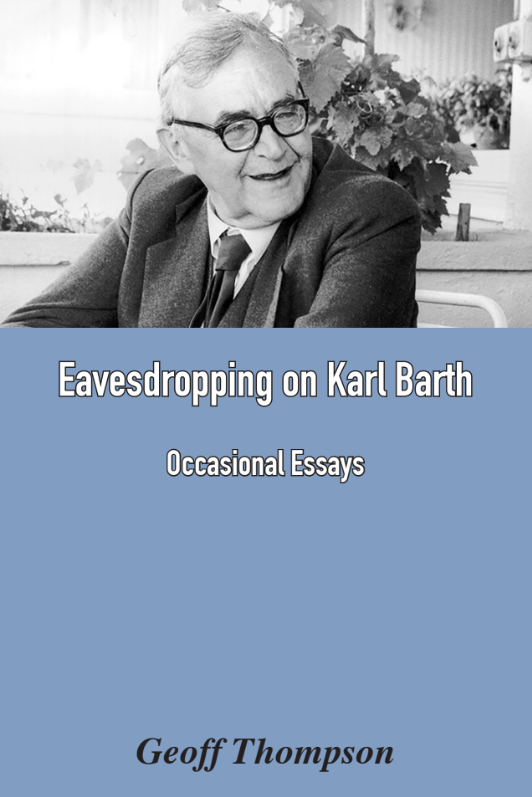
Just as Karl Barth called on Christians to ‘eavesdrop’ on the world to freshly hear the Word of God in
unexpected places, so these essays reflect the author’s own eavesdropping on what are often unexpected aspects of Barth’s own theology. A mix of previously-published and new essays, the collection brings Barth into conversation with a range of contemporary theological and cultural issues.
Endorsements
Karl Barth surprises us in these essays. In his assured and probing readings, Thompson demonstrates the continuing generativity of Barth’s theology for diverse contemporary issues including the ecological crisis, relating to religious others, and living in a post-truth culture. Avoiding apologetic defensiveness on one hand and reflexive dismissal on the other, Thompson’s approach shows how Barth remains a resource for the self-critical, always unfinished work of theology.
Amy Plantinga Pauw
Henry P. Mobley Jr. Emerita Professor of Doctrinal Theology, Louisville Presbyterian
Seminary, Kentucky
Karl Barth, Geoff Thompson reminds us, encouraged theologians to ‘eavesdrop in the
world at large’, attending to it with curiosity and openness. And curiosity and openness
are precisely the ways Thompson engages with Barth’s theology in this beautifully written,
acute and insightful collection of essays. If you know Barth well, this book will still reward
you; and if you only know Barth a little, this book will lead you through key themes in his
theology leaving you wanting to learn more.
Stephen Plant
Dean and Runcie Fellow, Trinity Hall, University of Cambridge
Through various deep probes into Barth’s writings, chiefly the Church Dogmatics, Geoff
Thompson does something better than throw a few more essays onto the ever-growing
mountain of Barth scholarship: he asks how Barth, critically appropriated, can help us
address some pressing theological issues. Engaging questions of culture, other religions,
other creatures, the marginalized, the nature of theology, and more, Thompson’s illuminating
studies show how theology can be done with Barth, and not simply about Barth.
Douglas Harink
Professor Emeritus of Theology
The King’s University, Edmonton
About the Author
Geoff Thompson taught systematic theology, first at Trinity Theological College (Brisbane) and then
at Pilgrim Theological College (Melbourne). In retirement, he is an Honorary Research Fellow of the
University of Divinity. He has published widely on the theology of the Uniting Church in Australia, and is the author of Christian Doctrine: A Guide for the Perplexed (T&T Clark, 2021). His long-
standing interest in Karl Barth stems from his PhD (Cambridge, 1996) on Barth’s notion of Christ’s self-witness outside of the Church.
Launch Speech
Fairfield UC, 24 Oct 2026
Daniel Sihombing
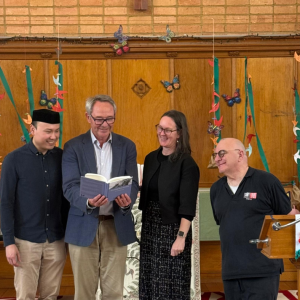 Good afternoon, everyone. It is a privilege to be asked to launch Geoff’s new book, Eavesdropping on Karl Barth. Congratulations, Geoff.
One of the things that I’ve learned so far in the Uniting Church is how many people hate Karl Barth. And some of them probably have good reasons. But this is interesting, considering that I first heard about the Basis of Union—the foundational document of the Uniting Church—from Benjamin Myers, in his essay on Karl Barth’s reception in Australia, where he writes about Barth’s theological influence in the document, that “in 1934, Karl Barth threw a stone into the pond; the existence of the Uniting Church in Australia is one of the ripples in the water.” (2012, 62). Maybe people will hate him even more after hearing this statement.
But Geoff is fully aware of this hostility—of course he does—and acknowledges the risk of writing another book, in his own words, “by one older white male about a dead white European male.” (10). Already in the mid-90s, as he mentions about his experience upon returning to Australia after his PhD study, his interest in Barth, in his words, “was frequently met with suspicion, sometimes regarded as quaintly dated, and treated as intellectually blinkered.” (161). And perhaps the thing that puts off many potential readers of Barth the most is the more recent revelation about his domestic life. As I often find that people are more interested in this topic rather than in Barth’s theology, you might be interested to check Geoff’s brief comment about the issue in page 10 and 11.
However, Geoff makes it clear that this book is not a “hagiographical endorsement” of Barth as a person. He says that it is not his intention “to invoke Barth as a white knight,” (161) and he acknowledges that much of Barth’s writings were written “from a position of … morally-problematic cultural privilege” (11). Geoff himself, as he admits in the introduction, never aspires “to be a Barth scholar” or “to champion Barth,” and that his interest in the theologian is coming from a “wider theological interests.” (10). The book is simply an engagement with Barth’s thought from these broader interests.
Barth’s theology, of course, has been studied in different ways, and approached from many angles. Some can be quite encouraging. Some can be quite depressing. It seems to me that what Geoff is trying to do is to counter the use or misuse of Barth’s theology of revelation in a way that denies inputs from the world. As he remarks in the first paragraph of the introduction, the title of the
book, Eavesdropping on Barth, is adopted from Barth’s exhortation to the church in Church Dogmatics IV/3, “‘to eavesdrop in the world at large’ in order to freshly hear and encounter the living voice of Jesus Christ beyond the sphere of scripture and proclamation.” (9). In other words, that at the heart of Barth’s theology is, indeed a strong Christological centering, but such
Christological centering calls for openness to the world, and readiness to be disrupted and challenged, because the voice of Jesus Christ cannot be confined within the walls of the church, and certainly not by a theologian like Barth himself. Thus in all of the ten essays that are collected in the book, you can see engagements with many different issues, from postmodernism (ch.1), cultural crisis (ch.2), religious pluralism (ch.3), ecology (ch.4), post-truth (7), the politics of solidarity (ch.8), the role of experience in theology (ch.9), and, last but not the least, on reading Barth in Australia (ch.10). All of the ten essays exhibit a combination of confidence in the gospel of Jesus Christ and a gesture of openness to the world. In engaging Barth with these issues and many different voices, Geoff also let those other voices disrupt and challenge some of Barth’s problematic premises and conclusions, while pointing out the rich possibilities within Barth’s theology itself. For example, in chapter 8, on “Christology, Discipleship and Solidarity in Karl Barth and M. Shawn Copeland,” Geoff highlights Barth’s often neglected presentation of the revolutionary ministry of Jesus and its radical call for discipleship, which urges a revolt against world orders. But he also put this idea into conversation with Shawn Copeland, an African-American, womanist, Catholic theologian, to challenge Barth’s tendency to overlook the importance of “reciprocal partnership.” (136).
But I suspect that many of us who are gathering here will be most interested to look at chapter 10, where Geoff narrates how Barth has been read in Australia, has been rejected by some, and whether his theology is still relevant in the present climate. I’ll leave it to you all to read it yourself and to make your own judgements.
So get yourself a copy at the back! And let us congratulate Geoff and celebrate this publication.