
Essays Ecumenical and Polemical Homage to Dietrich Bonhoeffer, Hans Küng, Martin Luther and John Henry Newman
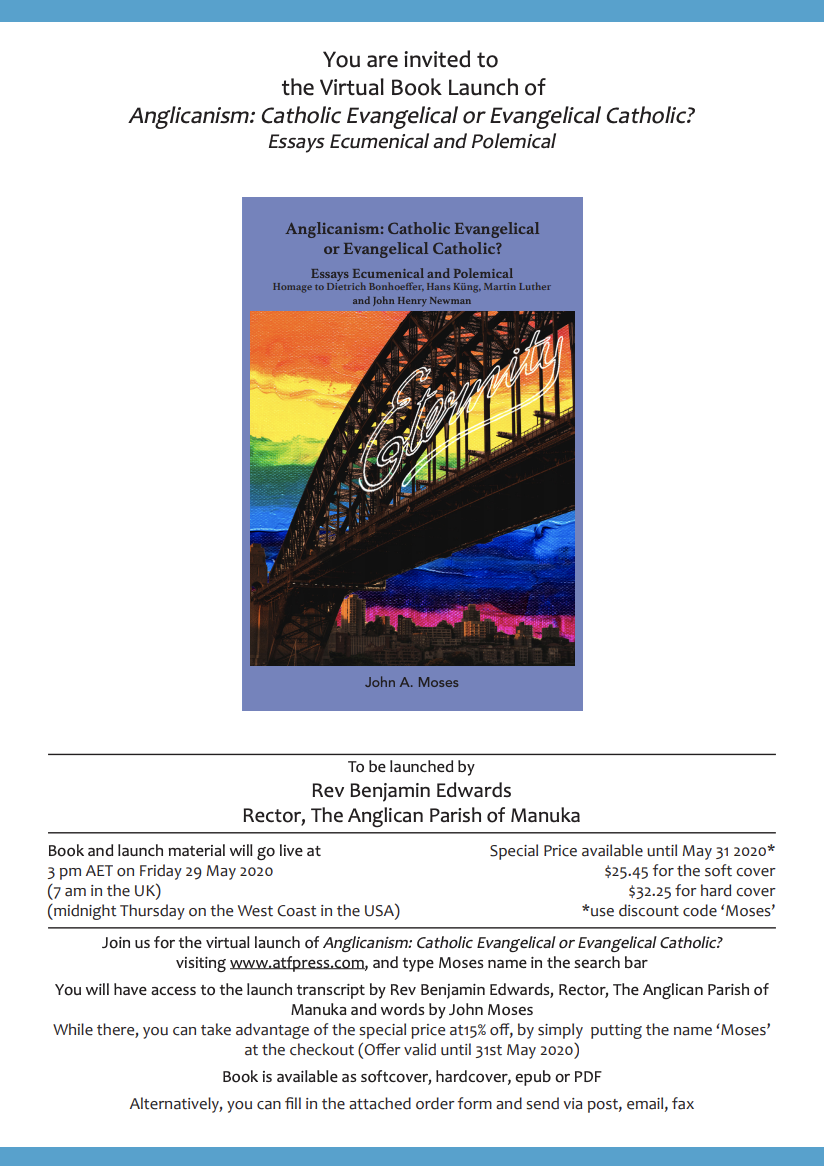
By John Moses
This book addresses the internal conflict within the Anglican Communion concerning the nature of the Church, its origins, structures and purpose. Through a series of essays it focuses on the question of the relationship between the Church, “the eschatological community of salvation” (Hans Küng) and the Scriptures, namely the variety of ancient records which the said community assembled over the first three centuries of its existence and used as the source for its liturgy and moral and social teaching. In particular the present book takes issue with those elements within the Anglican Communion who assume that the various books of the Bible taken as a whole represent the inerrant word of God. It is argued that people who make this assumption live in a parallel universe from where they demand that there is only one way to understand Scripture, namely their way and that failure/refusal to submit to this demand results in exclusion from the community of salvation. Instead it is maintained here that being a Christian means “being there for others” (Dietrich Bonhoeffer). The emphasis of Christianity should be the unconditional inclusive acceptance of “all sorts and conditions of men” [and women] and to exhort them to establish, justice and peace within society and among the nations and to work for the preservation and care of the earth which is God’s Creation.
Launch Speech
I want to thank Fr Ben for going to so much trouble to read my provocative little book. I am one of those priests who have been privileged to study long and hard in an alien culture, namely Germany such a long time ago now. My doctoral subject was, however, not theological at all, but the
history of the democratic labour movement. But I had studied for the Anglican priesthood and was very interested in the history of the Church in Germany ever since the Lutheran Reformation. And as I lived in a Lutheran student hostel in Munich which was made up of half German students male and female and the other half from just about every country in the world including Arabs and Jews I became very involved in both the inter-faith and ecumenical discourses.
It was a great learning curve because I really had to think through not only why I was a Christian but in particular an Anglican Christian. The Lutheran pastors and staff in charge of the hostel which was called Das Oekumenische Studentenwohnheim, the Oek-Heim [German is a fun language!]for short, made me very attuned to the common humanity we all shared despite of our cultural- religious differences. It really made me into a very ecumenical Anglican. Someone said once I was close to being an “ecumaniac.” I still am. And that is the main reason that I wrote the various essays that make up this book.
To be brief I would just say that it is important to keep the following
points in mind:
1. Everything we perceive apart from the natural world is a human artefact including the Bible. Therefore it is not the Word of God, as we used to hear, but man’s word about God. And it was not faxed down to earth in the King James’ version which some of our co-religionists affect to believe.
2. That is the same for all religions. All Holy Writ was conceived and authored by human beings. That is the case in Judaism, Islam, Buddhism, Sikhism etc and in the case of the so-called Abrahmic religions, namely Judaism, Christianity and Islam there is significant overlap.
3) In that case, why is Christianity preferable to us? The explanation is that it is an accident of history. However, due to multi-culturalism we have now a better opportunity to compare and contrast the practical outcomes of adherence to one or other of the different religious systems competing
for our allegiance.
4) I firmly believe that the best way to project our faith is to practise it openly, honestly and ecumenically. Our tradition has a lot to offer and others need to know who we are and what we stand for and when they do they will see we are not a closed shop but willing to encounter all comers from what ever part of the human family they come. Just as Jesus told us in his parable of the “Good Samaritan.” I hope my limited skills as an author have conveyed these ideas on my book.
Launch Speech 2: Benjamin Edwards
“In England, we have a curious institution called the Church of England. Its strength has always been in the fact that on any moral or political issue it can produce such a wide divergence of opinion that nobody — from the Pope to Mao Tse-tung — can say with any confidence that he is not an Anglican.”Auberon Waugh
One of the great ironies of twentieth century Christian history is that whereas inter-denominational sectarianism was considerably diminished by rapprochement and inroads gained by the rise of the ecumenical movement, a countervailing cleavage was emerging – the division between conservative and liberal or progressive and fundamentalist which often ran within denominations as well as across them. The central problem with which John’s collection of essays deals is both a legacy of this contemporary cleavage, albeit for Anglicans this is in many ways a pouring of old wine into new skins: the same old cleavages – evangelical/catholic, puritan/high church – continue. The danger of this division is a split personality – characterised by self-contradiction, inconsistency, and the distraction of internal conflict. Reckoning with this state of affairs in the context of contemporary Anglicanism is very much in John’s sights in this collection of essays. It is perhaps hardly surprising that, as the adherent of a Church he describes as ‘a theological debating society’, John has entered into polemical terrain. While a sort of myth of benign divergence of opinion and consensus has been the illusory resolution to the fragmentation and partisan theological positioning within Anglicanism, recent decades have exposed just how mythical this seems. Impasse, schism, distrust and a real lack of charity have marred the wider life of our Church – and this contagion has infected all levels of our polity, from Primatial and Communion interactions, to the diocesan and even parochial levels.
Exploring the contemporary symptoms of the chronic Anglican identity crisis as he has experienced them, John not only acknowledges the elephant in the nave but saddles it up for a figure of eight procession. With stations along the processional route at a few shrines, grottos and tombs including: How we handle the Scriptures; The role of intellectual insight, culture and tradition in the life of faith; contemplation of the pitfalls of intellectual laziness and dishonesty and the ways by which closed thought systems and non-thinking piety – what John dubs “cognitive dissonance in parallel universes” – actually undermine the essentials of Christianity – love, compassion, hospitality and care –; the need for a deeper appreciation of the Church’s history to understand its ecumenical potential; and the vocation to ecumenical rapprochement through via media Christianity which Anglicanism is neglecting. John is forthright, provocative and polemical in his expression of opinion in leading us on this procession.
Having served in a rural diocese where the Anglican consensus has worked – where people have not sought to dominate and undermine those from whom they differ in churchmanship or theological bent – I know this is possible. John is calling us to remember that and do something about it. This is also a call to middle-ground of Anglicanism to make its case. We hear in John’s polemical voice the call to theological insight, historical insight and efficacious demonstration of the vitality and relevance of the Anglican synthesis of Scripture, tradition and reason in a heavily secular society such as ours – and not to dissolve into what he describes as the ‘broad lazy middle’ of the church.

Anglicanism: Catholic Evangelical or Evangelical Catholic?
In this collection of essays John Moses combines the critical eye of a professional historian with the passion of a dismayed churchman in his analysis of the current malaise of the Anglican Church of Australia. His analysis is indebted to his study of totalitarianism in Nazi Germany and Soviet Russia, as he calls for a recovery of tolerance and a renewed commitment to intellectual engagement wi…